
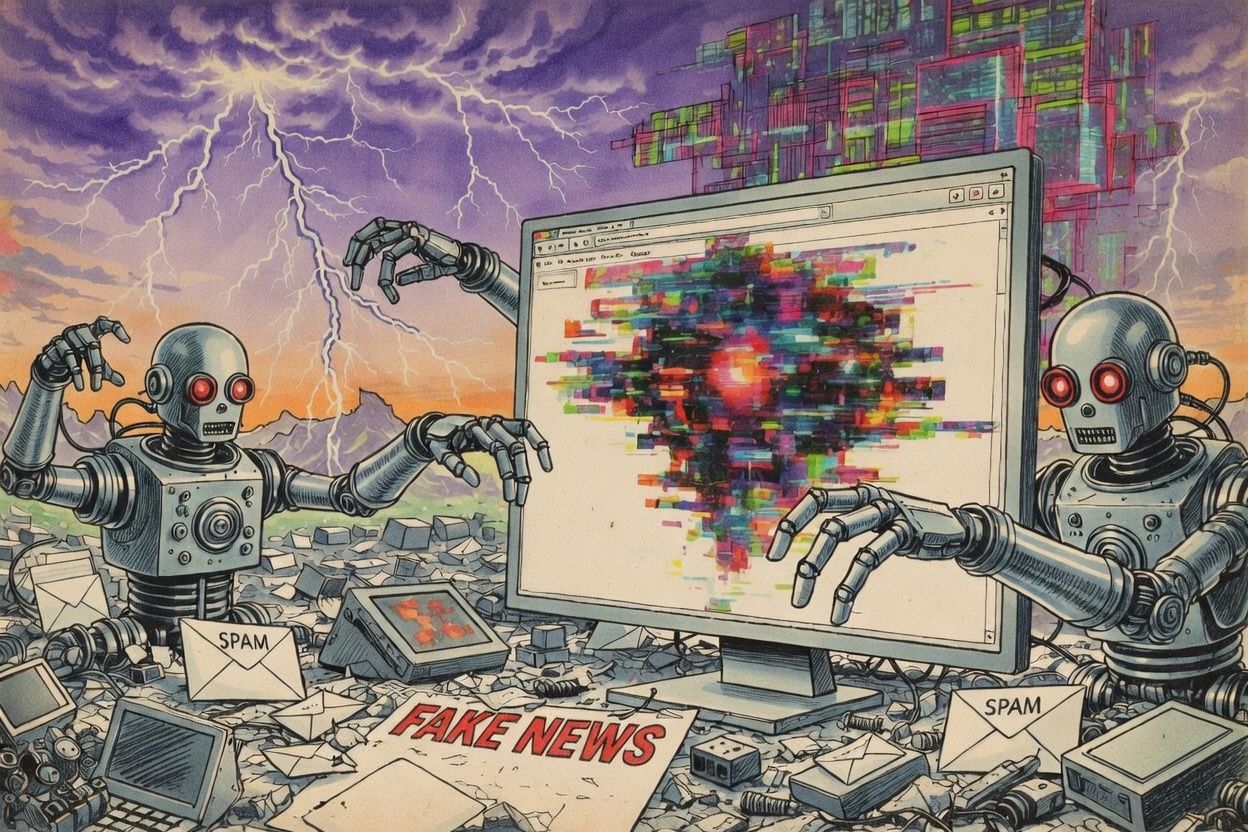
AI is destroying the Internet. That may sound dramatic at first. However, after years of working online — researching technical problems, maintaining servers, reading documentation, and writing about technology — I’ve watched the web slowly fill with bots, AI spam, fake engagement, and low-value content.
AI is destroying the Internet.
Yes, that sounds dramatic. However, once you look closely at search results, social feeds, fake reviews, bot activity, and machine-generated junk pages, it starts to sound less like a hot take and more like an obvious description of what is already happening.
For a long time, the Internet felt like it belonged to real people. Blogs had personality. Forums had depth. Niche websites had quirks. More importantly, search engines often led you to someone who actually knew what they were talking about. If you searched for Linux advice, WordPress troubleshooting, server tuning, or cybersecurity guidance, you could often find a real person sharing real experience.
Now, that experience is getting harder to find.
Instead, the modern web is increasingly filled with AI-generated content, automated engagement, synthetic media, fake authority, and pages built primarily to satisfy algorithms. As a result, many people feel like something is off. They are right. AI is destroying the Internet by replacing authentic human content with scalable artificial noise.
The web is not just getting bigger. Instead, it is becoming more artificial, less trustworthy, and significantly harder to navigate.
AI Is Destroying the Internet by Replacing Human Content
The early Internet felt human because it actually was human. People built websites because they cared about what they were writing about. They were hobbyists, engineers, sysadmins, tinkerers, writers, nerds, and obsessives. They made pages about Linux, electronics, theology, cars, investing, programming, networking, photography, and every other niche you can imagine. Consequently, you could find articles with an actual point of view, actual detail, and actual expertise.
By contrast, much of today’s web is manufactured. AI now drafts huge numbers of articles. AI generates images. Social posts are mass-produced. Companies now automate entire publishing pipelines from keyword research to article generation. In other words, content is increasingly being created for ranking systems and recommendation engines first, and for actual human readers second.
That shift matters. Once machines produce most of what people read online, the Internet stops feeling like a community and becomes a content refinery.
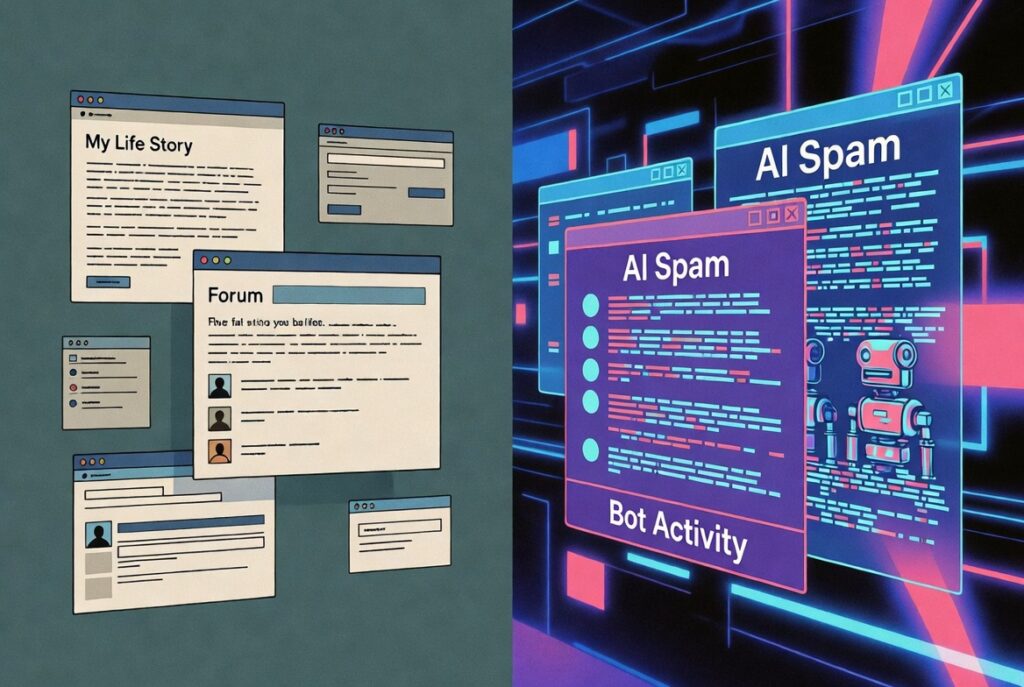
Another AI-generated image – I’m not a great graphic artist.
Before AI Started Destroying the Internet
The old web was messy, but that was part of the charm. It was also useful. You had personal websites, small forums, hobbyist blogs, open communities, and weird little corners of the web built by people who clearly cared. The design was not always polished, but the content was often excellent.
- personal websites with a real point of view
- forums with deep technical discussions
- blogs written by people who had actually done the work
- small communities built on trust and shared interests
For example, if you wanted to harden a Linux server, tune NGINX, optimize MariaDB, fix a broken WordPress plugin, or troubleshoot some bizarre networking problem, you could often find a blog post from someone who had actually dealt with it. It might not have looked pretty. Nevertheless, it was real, and that mattered.
Today, the web often looks more polished but feels much more hollow.
How AI Is Destroying the Internet With Content Farms
One major reason AI is destroying the Internet is simple: scale. Modern AI tools let a single operator generate huge volumes of text in almost no time. Therefore, entire sites can now be built at very little cost, with very little expertise, and with minimal human involvement.
A typical AI content farm often works like this:
- Find keywords with traffic potential.
- Generate articles in bulk using AI tools.
- Publish them automatically and continuously.
- Monetize the resulting traffic with ads, affiliate links, or lead capture pages.
From a business standpoint, the incentive is obvious. If content becomes cheap enough, volume becomes the strategy. Even if only a fraction of those pages rank, the operator can still make money. Consequently, the web gets flooded with pages that exist to capture attention rather than provide value.
This is exactly why so much content now feels repetitive, generic, and strangely lifeless. It was not written to help you. It was written to get in front of you.
Why AI Content Farms Keep Winning
They keep winning because the incentives are broken. Search engines and social platforms often reward signals that AI can generate at scale:
- publishing frequency
- keyword coverage
- content volume
- engagement bait
- low production cost
As long as platforms reward output more than originality, synthetic content will keep spreading. Therefore, the amount of AI slop on the Internet will almost certainly continue to grow.
Dead Internet Theory and Why It No Longer Sounds Crazy
The dead Internet theory argues that much of the modern Internet is no longer driven by genuine human activity, but by bots, automation, and artificial amplification. Some versions of the theory definitely drift into conspiracy territory. Even so, the central idea now feels much more believable than it did a few years ago.
Look at what is already everywhere:
- AI-written articles showing up in search results
- bot accounts posting nonstop on social platforms
- fake engagement inflating low-value content
- synthetic reviews distorting product decisions
- AI-generated images replacing real creative work
Even if the Internet is not literally dead, it is clearly becoming less human. That is why the dead Internet theory resonates with so many people. It gives a name to a feeling users already have: the web increasingly feels fake.
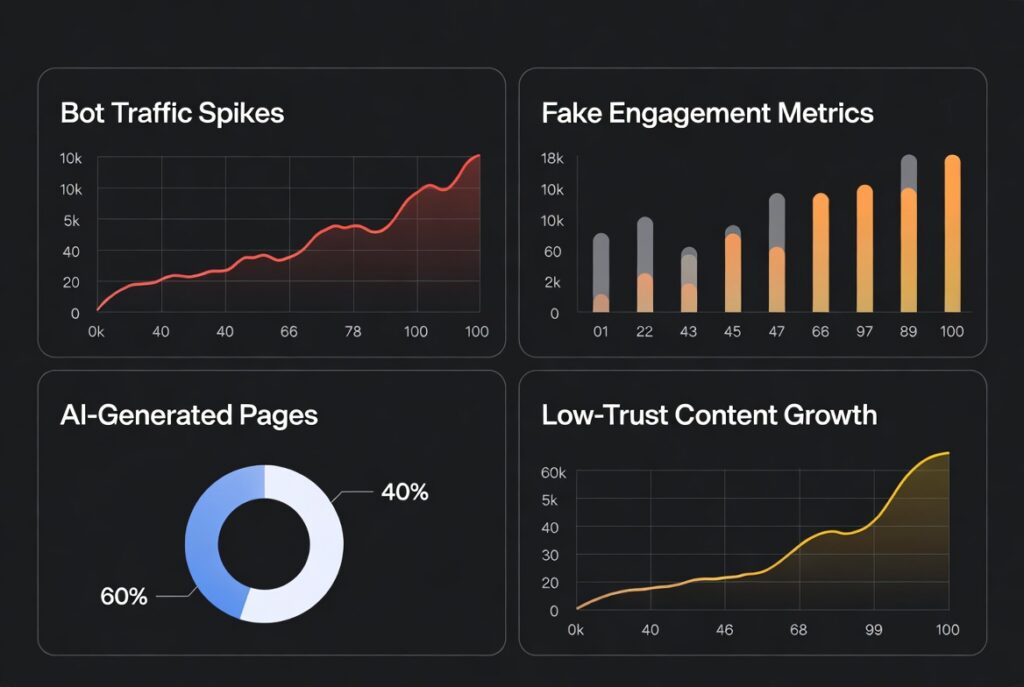
This is an AI-generated image, and these graphs are for illustrative purposes only.
Why Search Results Feel Worse Because AI Is Destroying the Internet
Many people have noticed that finding good information online is harder than it used to be. Search still works, of course. However, the average quality of many results often feels worse. That is not just nostalgia talking.
Increasingly, search results are crowded with:
- thin AI summaries
- SEO-first articles with no firsthand experience
- pages overloaded with ads and affiliate links
- rewritten content that adds little or nothing new
As a result, users have to work harder to find something genuinely useful. Ironically, the explosion in content has made useful information feel scarcer. More pages do not create more knowledge. In many cases, they just create more clutter.
AI Is Destroying the Internet’s Knowledge Layer
The Internet’s real strength was never just scale. It was the ability to connect people to real expertise. Once machine-written summaries begin replacing experienced voices, that knowledge layer starts to erode.
This matters in every niche, including:
- cybersecurity
- Linux and infrastructure
- health and wellness
- finance and investing
- product reviews
- technical tutorials and education
If everyone starts publishing derivative AI sludge, readers will increasingly struggle to tell the difference between genuine experience and machine-generated imitation. That is bad for users, bad for publishers, and bad for trust across the web.
How Social Media Proves AI Is Destroying the Internet
This problem is not limited to websites. Social media is also being reshaped by AI-generated content and automated amplification. A single operator can now run multiple accounts, generate endless posts, schedule replies, simulate engagement, and manufacture the appearance of influence.
Consequently, social platforms are filling with:
- automated commentary accounts
- engagement-farming threads
- AI-generated memes and images
- mass-produced opinion posts
- synthetic personas built for attention or monetization
Because of that, the line between real conversation and manufactured activity keeps getting blurrier. The feed may look active, but that does not mean it is authentic.
Cybersecurity Risks of an Internet Flooded by AI
There is also a serious security angle here. An Internet flooded by AI is not just annoying. It is dangerous.
AI tools can help attackers generate:
- convincing phishing emails
- fake support messages
- fraudulent landing pages
- fake reviews and reputation manipulation
- high-volume social engineering campaigns
Moreover, these systems can personalize attacks at scale. In the past, many scams were easy to spot because they were crude, repetitive, or obviously fake. Now, however, AI can generate polished and targeted messages with very little effort. That lowers the barrier to entry and increases the amount of malicious content online.
So yes, AI is destroying the Internet culturally. At the same time, it is also making the Internet more hostile from a cybersecurity standpoint.
Why AI Is Destroying the Internet: The Incentives Are Broken
Importantly, this is not happening because every developer or company has bad intentions. Rather, it is happening because the modern web rewards the wrong things. Platforms reward what is easy to measure:
- clicks
- impressions
- engagement
- publishing frequency
- keyword coverage
AI is extremely good at generating those signals. Therefore, companies using AI at scale often get rewarded even when the user experience gets worse. Until major platforms start prioritizing originality, trust, and demonstrated expertise much more aggressively, this trend will continue.
What the Future Internet Might Look Like
The Internet is not going away. However, it may split into layers.
One layer will be the synthetic web: AI-generated pages, automated feeds, bot amplification, and machine-to-machine content. The other layer may become smaller, slower, and much more human.
For example, the next wave of trust online may grow in:
- private forums and curated communities
- verified human publishing systems
- email newsletters and direct subscriptions
- smaller niche blogs with strong trust signals
- reputation-based communities instead of scale-based feeds
Ironically, the same technologies making the public web worse may push people back toward smaller and more trusted spaces.
What Bloggers and Site Owners Should Do While AI Is Destroying the Internet
If you run a website, this trend should not push you toward despair. Instead, it should push you toward differentiation. The more synthetic the web becomes, the more valuable real experience becomes.
That means focusing on:
- firsthand experience
- original screenshots and examples
- real case studies and lessons learned
- strong author voice
- technical depth and trust signals
For instance, if you write about Linux, WordPress, NGINX, DevOps, infrastructure, or security, do not just summarize generic advice. Show real configurations. Show real problems. Show what broke, what fixed it, and what you learned. That is the kind of content AI imitators struggle to fake convincingly.
You should also strengthen your internal linking so readers can move naturally into related articles. For example, this post should connect to your content on Linux servers, website hardening, NGINX performance, WordPress security, and small business cybersecurity. That helps SEO, but it also reinforces topical authority where your firsthand experience actually matters.
The Internet Is Not Dead Yet, but It Is Becoming Less Human
The strongest version of this argument is not that the Internet has already died. It is that the web is becoming progressively less human as automation floods more of what we read, search, and share.
That is why the phrase AI is destroying the Internet resonates so strongly. It captures the growing sense that something essential is being lost. The web used to connect people to people. Now, increasingly, it connects people to machine-generated approximations of people.
That shift has cultural consequences, economic consequences, and cybersecurity consequences. Most importantly, it has consequences for trust.
If the Internet becomes dominated by machines talking to machines, genuine human insight becomes harder to find. Therefore, the next era of the web may belong not to those who publish the most, but to those who can still prove they are real.
Final Thoughts on Why AI Is Destroying the Internet
So, is AI destroying the Internet? In many ways, yes. It is flooding the web with synthetic content, diluting trust, amplifying noise, and making it harder to discover the authentic. Nevertheless, this same shift also creates an opportunity for real experts, real builders, and real independent publishers.
The more artificial the Internet becomes, the more valuable authentic human knowledge becomes.
That is where the next battle for the web will be won or lost.
About the Author
Kevin Worthington is a software engineering and cybersecurity professional with hands-on experience with Linux servers, web infrastructure, WordPress, performance tuning, and security hardening. He writes about practical technology, cybersecurity, infrastructure, and the changing shape of the modern web at kevinworthington.com.
Frequently Asked Questions About AI Destroying the Internet
Is AI really destroying the Internet?
AI is not destroying the Internet in a literal sense, but it is making the web feel less human by flooding it with low-value content, bots, fake reviews, and synthetic media. As a result, many users feel that trust and quality are declining online.
What is the dead Internet theory?
The dead Internet theory is the idea that much of the modern Internet is driven by bots, automated systems, and artificial amplification rather than genuine human activity. While some versions are exaggerated, the growth of AI-generated content has made the theory feel much more plausible.
Why do search results feel worse now?
Search results often feel worse because the web is increasingly saturated with AI-generated articles, SEO-first pages, affiliate-heavy content, and rewritten summaries with very little original expertise. Consequently, useful pages can be harder to find.
How can bloggers stand out in an AI-saturated Internet?
Bloggers can stand out by publishing firsthand experience, original screenshots, real examples, strong opinions, and technically accurate guidance. In other words, authenticity and depth are becoming more valuable, not less.
Will AI-generated content hurt SEO over time?
It can if the content is generic, inaccurate, or lacks originality. Although AI can help with drafting and ideation, websites that rely too heavily on low-value automation risk losing trust, links, and long-term engagement.
What do you think? Is AI improving the web, ruining it, or simply exposing problems that were already there? Leave a comment and say what you are seeing in search, social media, or your own corner of the web.
If your business needs a faster, safer, and more trustworthy web presence, submit a service request through KEVINDUSTRIES.