
Hacked

So my band’s website and my business website (which is in its infancy) got hacked by the “Red Hackers Association.” My hosting provider for those sites have still not fixed the problem. Note that this site that you are currently viewing is not hosted by that company, but on my cable modem connection. Both sites were offline on Tuesday through Thursday (August 1st – 3rd), and today have the defaced rhetoric:
Hacked websites

Here’s the full text of theire defacement:

Red Hackers Association / RedHack Team (Kizil Hacker’lar)

� own with Israeli sionism and barbarism! Down with the US imperialism! Long live the international solidarity of peoples! Long live socialism! Israel is doomed to be destroyed, the peoples of Middle East and the rest of the world will annihilate! – Abas la imperialisme est sionisme. Abas la Israel. Vive la solidarlite international des peuple. Vive RedHack �

MaNYaK | Tio | CrX | Partizan | Cruel | drk4ph3x | Csoft

Red Hackers Association / REDHACK TEAM 1997-2006

Abas La imperialisme und Sionisme. Hoh Di Internationale solidarlited – Israil Assasino!! AND F@#$ USA and ISRAEL

irc.ulak.net – #redhack
Her$ey iLLegaL .]

red-hack.org

Raise The fLag Of SociaList StruggLe Toward ImperiaList War And CapitaList CoLony..!

Thanks, jerks.

PLEASE NOTE: Native Lighttpd Windows builds are available at en.wlmp-project.net/
The last available Lighttpd for Windows build that I created using Cygwin was Lighttpd for Windows 1.4.17.
Updated September 29, 2009.

lighttpdBefore I start, I want to put up a quick disclaimer:

This guide is intended to help people who want to compile lighttpd for Windows using the Cygwin environment. It is just a basic, short how-to to help you get started. It is in no way complete by any means. I am assuming a lot of things in this tiny tutorial. For example, that you are running 2000, NT, XP, or 2003 Server, and NOT 95/98/Me or something ancient like 3.1 or DOS 6.22. I will also assume that you have Cygwin installed with all associated build tools, and that you have some familiarity with Cygwin or a Unix/Linux shell.
Ok, with that said, are you ready? OK here goes:

Untar and un-gzip the lighty source package and enter its directory. Run:
./configure –prefix=C:/whatever/directory/you/want
(NOTE: use forward slashes above. Also, that is it “dash dash prefix” – 2 dashes.)
make
make install

Create a lighttpd.conf (or copy a previous .conf) to the etc directory
in your lighty install path. Try to run lighty from within the sbin
directory (from a C: prompt, not in the Cygwin environment):
lighttpd -f ..etclighttpd.conf (NOTE: use backslashes this time)

It will complain about cygwin1.dll missing. Copy it from C:cywginbin (or where ever you installed cygwin) to lighty’s sbin directory. It will complain about more files missing; simply repeat the same procedure of copying the missing files from cygwin’s bin directory to lighty’s sbin directory. It will run eventually, test by going to http://127.0.0.1 (localhost) once an error does not pop up.

For more hints, check out the contents of the batch files I provide in
the sbin directory, and good luck.

I will accept comments in order to help other do-it-yourselfers, but I will only make corrections to this mini-guide if I’ve made a huge mistake. Please do not point out that this guide is incomplete. I already know that, and have said it above. Thanks.

Reference: lighttpd forum – http://forum.lighttpd.net/topic/1102#2997 (Wayback Machine link; original seems gone.)

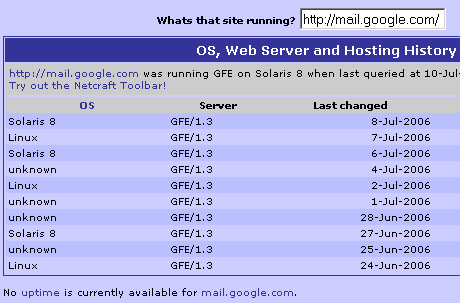
According to Netcraft, GMail is alternating between Linux and Solaris 8?
Netcraft - Google running Solaris 8?
I always read and heard that Google runs Linux exclusively on their huge cluster.
So I wonder if…:

  • …Netcraft is determining the operating system incorrectly
  • …Google is actually using Solaris 8 on some of their machines in the cluster
  • …Google is using a few systems with Solaris as a “gateway” to their Linux cluster
  • …I am the first person to notice this outside of Google. (Or at least the first to create a blog entry about it.)

Maybe we will hear something official. Or if there has been some kind of information released by Google regarding Solaris 8, please add a link to it within the comments.

P.S. – If you were wondering what GFE/1.3 is, it is Google’s web server software, which is rumored by some people to stand for Google Front End (version 1.3).